Algorithm-Dynamic Programming
- Divide-and-Conquer: 子問題彼此獨立、不重複
- Dynamic Programming: 子問題會重複出現,要記下來避免重算
- 使用DP的時機: 線性的排序法 + 無法重新排列
- Optimal Substructure: 整體最佳解可以由子問題的最佳解組合而成
- Overlapping Subproblem: 同一個子問題會被反覆計算很多次 </span>
- 常見例子
- Linear assembly lines
- matrices in a chain
- characters in a string
- points around the boundary of a polygon
- points on a line/circle
- the left to right order of leaves in a search tree
- …
- 在DP問題中,subproblem的最佳解不見得是overall的最佳解
- DP問題可以直接畫表格的方式,用簡單的計算就知道哪一個solution是optimal(Tabular Method)
| 面向 | Divide-and-Conquer | Dynamic Programming |
|---|---|---|
| 子問題關係 | 彼此獨立 | 大量重疊 |
| 是否記憶結果 | ❌ 不需要 | ✅ 必須(memo / table) |
| 典型技術 | Recursion | Recursion + Memoization 或 Iteration |
| 時間優化關鍵 | 問題切得平均 | 避免重複計算 |
| 思考重點 | 怎麼「分」 | 狀態如何「轉移」 |
Assembly-line Scheduling
- Shortest Path Algorithm也是需要DP的觀念
- 只要記得最短路徑這個最佳解就好,其他路徑不重要
車子組裝生產線例子
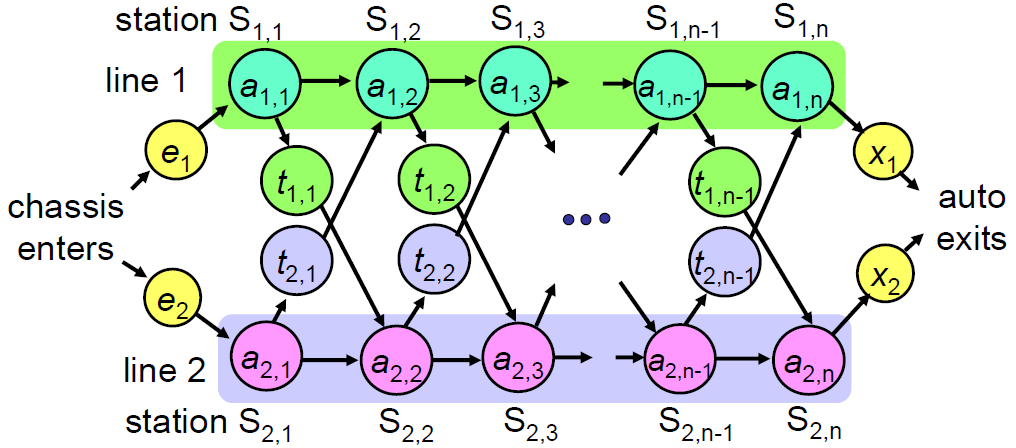
- Objective: 在例子中,找一個生產線的走法,使時間成本更少
- 可以轉換生產線,但要付出時間成本$t_{i,j}$ → $i$代表生產線,$j$代表需要的station
- Worst Case: $\Omega (2^n)$: 暴力法
解法
- 先找到Optimal Sustructure 要找到$S_{1,n}$之前的最佳解,需要從入口到$S_{1,n-1}$之前的最佳解,把之前的路徑用divide and conquer解就可以了。
- 先找到Overlapping Subproblem
- $f_i[j]$代表從起點到$S_{i,j}$最短的時間,目前先考慮第一條生產線,如果$j$只有一個那就只有一種走法;大於兩條之後,可以考慮換生產線,當然要加上轉換的時間,這個是用table的方式呈現,分別紀錄$f_{1,1},f_{1,2},f_{1,3},…,f_{1,n}$和$f_{2,1},f_{2,2},f_{2,3},…,f_{2,n}$分別是多少,以本例子來說是一個2*n的table size
- 實際的Pseudo Code
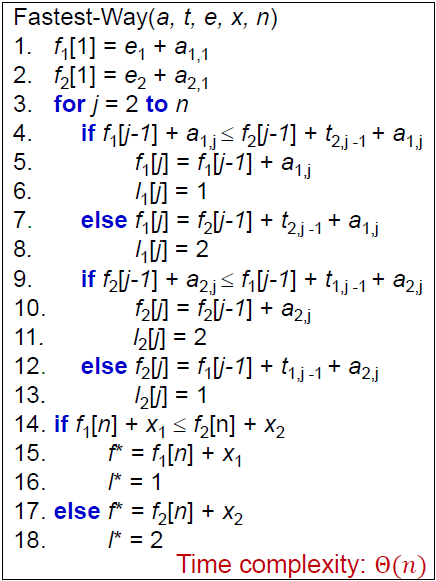
- 仔細看pseudo code還蠻簡單的,就只是實作出前面寫的formula而已
- asterisk symbol代表optimal solution
- 前面的$f$已經紀錄到$S_{i,j}$的最短路徑是多少,可是到底是從哪一條生產線來的不知道,所以需要另外一個table來紀錄,這就是$I$這個table存在的目的,大小是x*(n-1)
Matrix-chain subsequence (矩陣相乘以及相乘的順序)
- $A$是pxq matrix;$B$是qxr matrix;$C=AB$是pxr: $C[i,j]=\sum\limits_{k = 1}^q{A[i,k]B[k,j]}$
- Time Complexity: $O(pqr)$
1 | |
3個矩陣以上就會有順序的問題
- Objective: 使乘法數量越少越好
- 例子: $A_1$: 4x2;$A_1$: 2x6;$A_3$: 5x1
- $(A_1A_2)A_3$: 4*2*5+4*5*1=60
- $A_1(A_2A_3)$: 2*5*1+4*2*1=18
- 問題: 要怎麼知道一個Matrix-Chain怎麼乘會讓乘法的operations數量最少?
-
BruteForce: $P(n)$代表$n$個矩陣相乘的方法有多少種,$\Omega({4^n\over {n^{3/2}}})$
\[P(n) = \left\{ \begin{array}{l} 1, \text{if}\ n = 1 \\ \sum\limits_{k=1}^{n-1}{P(k)P(n-k)}, \text{if}\ n \ge 2 \end{array} \right.\]
-
- 先判斷能不能用DP
- 因為matrix chain是linearly ordered並且不能rearranged(每一種矩陣都要存在並且順序不能被改變)
- Optimal Substructure:如果最優解在第 $k$ 個位置切開,那麼左半部$A_i,…A_k$,右半部$A_{k+1},…,A_j$都一定各自是最優的,否則:如果左邊不是最優,換成更好的左邊,整體一定更好(矛盾)
- Overlapping Subproblem: 子問題是什麼?$m[i][j]$計算$A_i,…,A_j$代表最小成本,當計算$m[1][4]$和$m[2][5]$,都會用到$m[2][4]$
利用DP解決-Iterative Bottom-Up
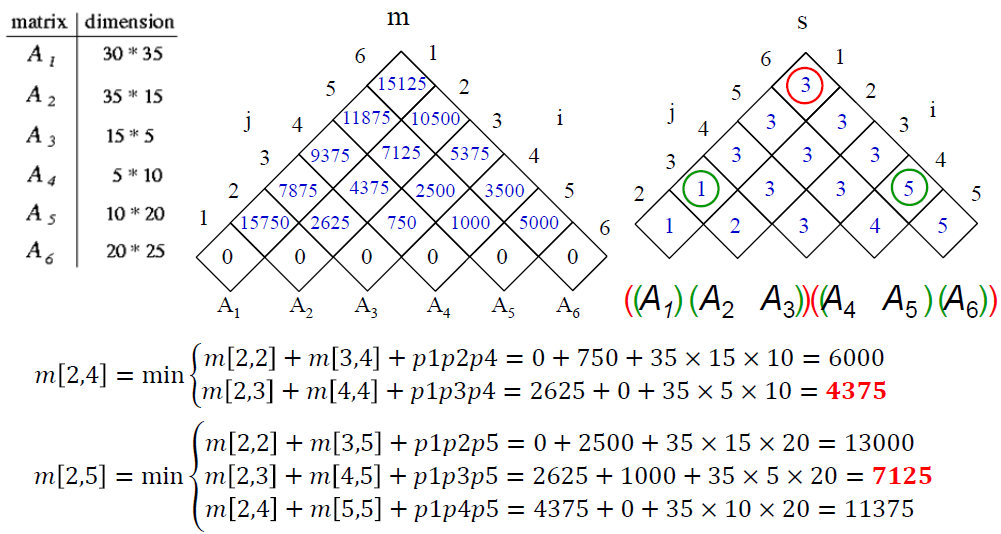
這也很簡單,只要自己推過一層就會了,也是有兩個table一個記錄矩陣相乘的operations數量,另外一層則紀錄從哪裡切會是最小值。屬於bottom-up的想法
- 一開始先計算$A_1A_2$,$A_2A_3$,…,$A_{n-1}A_n$共$n-1$各是多少
- 然後計算$A_1A_2A_3$,$A_2A_3A-4$,…,$A_{n-2}A_{n-1}A_n$共$n-2$各是多少
- 以此類推就可以建立上述的兩個table,個人認為是比較聰明的brute force
1 | |
1 | |
利用DP解決-Top-Down Recursive Matrix-Chain Order(不推薦)
- 使用這個邏輯解題會有很多問題被重複解,很浪費時間,DP還是建議用bottom-up
- Time: $\Omega (2^n)$: $\sum\limits_{k=1}^{n-1}(T(k)+T(n-k)+1)$
1 | |
利用DP解決-Top-Down Memorization Matrix-Chain Order
- 把subproblem的解記憶起來就不會發生重複解的問題
- Space: $O(n^2)$
- Time: $O(n^3)$
1 | |
1 | |
Longest Common Subsequence
DNA比對例子
- Input: $X_m=<x_1,x_2,…,x_m>$, $Y_n=<y_1,y_2,…,y_n>$
- Output: $Z_k=<z_1,z_2,…,z_k>$: LCS of $X_m$ and $Y_n$
先判斷能不能用DP
- Optimal Substructure:
- Case 1: $x_m=y_n$代表兩個sequence的最後一個element是一樣就可以直接放到$Z$中,並且繼續往前比對$X_{m-1},Y_{n-1}$
- Case 2: $x_m\ne y_n$代表兩個sequence的最後一個element不一樣
- Case 2-1: 則$z_k\ne x_m$代表$Z$是$X_{m-1}$和$Y$的LCS
- Case 2-2: 則$z_k\ne y_n$代表$Z$是$X$和$Y_{n-1}$的LCS
\(c[i,j] = \left\{ \begin{array}{l} 0, \text{if}\ i = 0\ \text{or}\ j=0 \\ c[i-1,j-1], \text{if}\ x_i = y_i, j\lt 0 \\ \max(c[i,j-1],c[i-1,j], \text{if}\ x_i \ne y_i, j\lt 0 \end{array} \right.\)
- $c[i,j]$代表$X_i$和$Y_j$的LCS長度
- 當某一個sequence為零,則LCS一定為零
- Overlapping Subproblem: LCS(5, 5) 和 LCS(6, 5)都會算 LCS(5, 4) ➡️ 同一個 (i, j) 被重算很多次
利用DP解決-Bottom-Up
- Time: $O(mn)$就是二維table的大小
1 | |
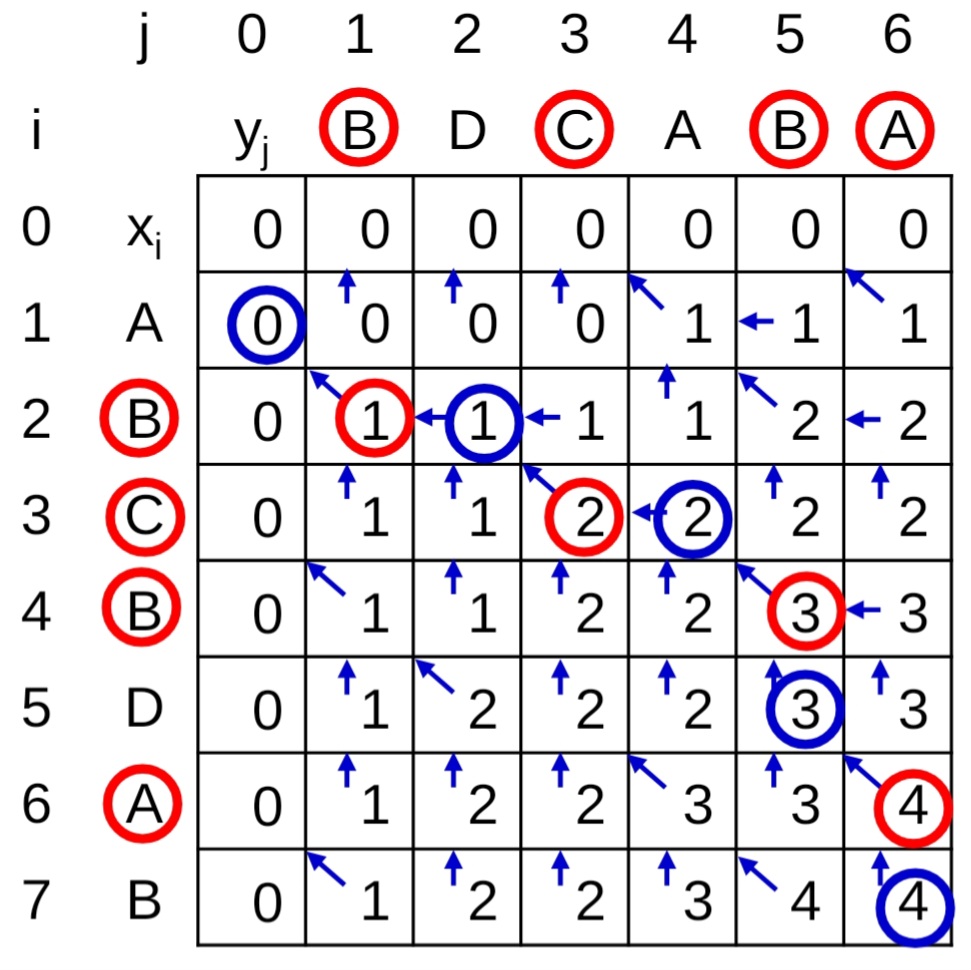
- Input: $X=<A,B,C,B,D,A,B>, Y=<B,D,C,A,B,A>$
- Output: $LCS=<B,C,B,A>$
- 從上到下或從左到右填入
- 當$A\ne B$,去看$j-1$和$i-1$誰大,兩者都是零就直接填上方的零,箭頭是為了方便trace,只要看到左斜的arrow,就把對應的字母圈起來
1 | |
Optimal binary search trees
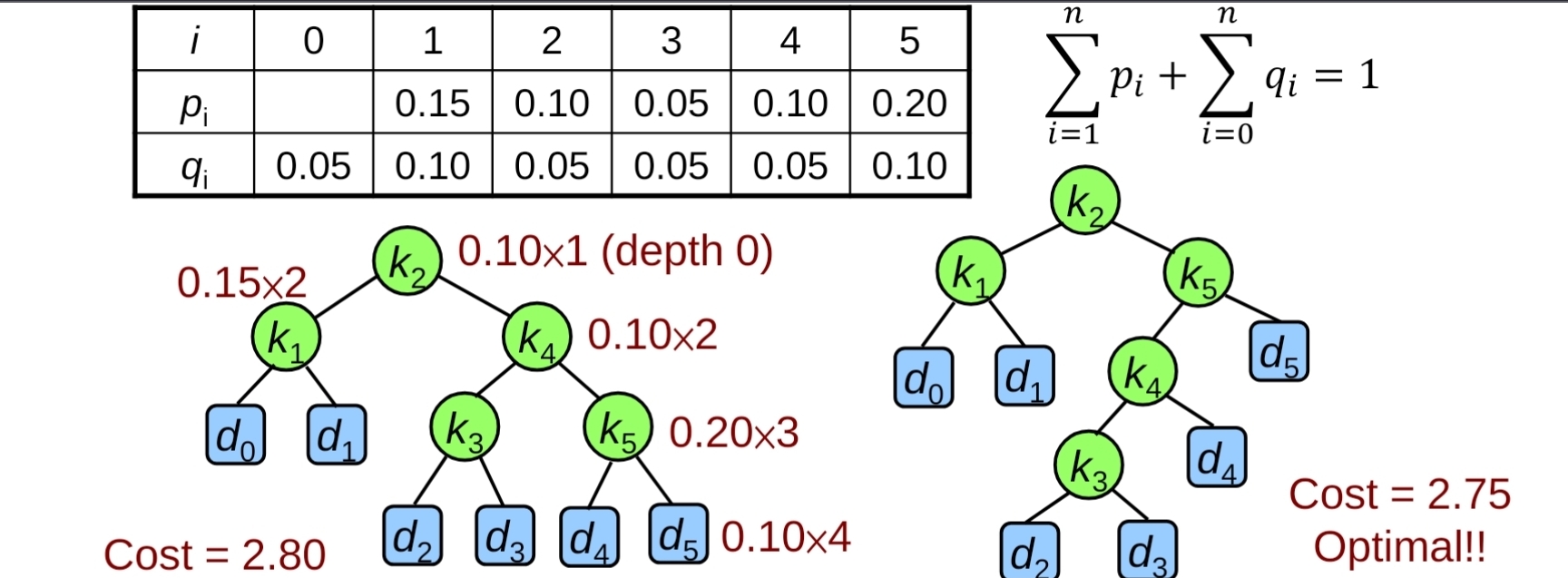
- Input:
- $K=<k_1,k_2,…,k_n>$: 給定一個已經sorted的不同的key,可以想像成英文字典的概念
- 每個key都會有找的到的機率$P=<p_1,p_2,…,p_n>$
- 而$D=<d_1,d_2,…,d_n>$代表沒有出現在字典的那些key
- 對於那些沒有在字典的key也會有找不到的機率$Q=<q_1,q_2,…,q_n>$
- Objected: 找搜尋成本最低的binary search tree
- 成本計算方式: 算找的到的key的期望值 + 找不到的key的期望值,用深度+1的方式當作成本
利用DP解決-Recurrence
- Optimal Substructure: 核心邏輯是如果BST $T$有一個subtree $T’=<k_i,…,k_j>$,則這個$T’$對於$k_i,…,k_j,d_{i-1},…,d_j$也一定要是optimal,所以其實和之前的DP問題一樣,例如Matrix-chain subsequence,都是用金字塔表格,假設在最優解中,區間 $[i,j]$中 的 root 是 $k_r$,那麼一定滿足:左子樹 $[i,r-1]$ 是 最佳的;右子樹 $[r+1,j]$ 是 最佳的,如果左子樹不是最佳,換成更好的左子樹,整體期望成本一定更小(矛盾)
- Overlapping Subproblem: 在計算不同區間時,會反覆用到同一個子區間,例如 E[2][4] 會出現在 E[1][4](root = 1)、E[2][5](root = 5)
總共需要4個table
- 原本儲存找的到和找不到key的機率$P,Q$
-
$w[i,j]$: 表示「子問題區間 i 到 j 的所有搜尋機率總和」,用來快速計算期望成本,避免之後要用到還要重複計算,增加DP的效率
\(w[i,j] = \left\{ \begin{array}{l} q_{i-1}, \text{if}\ j = i-1 \\ w[i,j-1]+p_j+q_j, \text{if}\ i\lt j \end{array} \right.\) 也就是:
- 區間內 所有成功搜尋機率
- 加上 夾在中間的所有失敗搜尋機率
-
$e[i,j]: $代表$k_i$到$k_j$的optimal binary search tree的期望值(預期搜尋成本)
\[e[i,j] = \left\{ \begin{array}{l} q_{i-1}, \text{if}\ j = i-1 \\ \min\limits_{i\le r\le j}\{e[i,j-1]+e[r+1,j]+w(i,j)\}, \text{if}\ i\lt j \end{array} \right.\] - $root[i,j]$: 代表在$k_i,…,k_j$中有一個$k_r$最適合當作root達到optimal,也就是紀錄optimal solution怎麼來的
- Objective: 要慢慢推導到$e[1,n]$
Pseudo Code
1 | |
反正就是按照table分別填入$w,e,root$,最後只要看root table就可以知道OBST的結構長怎樣
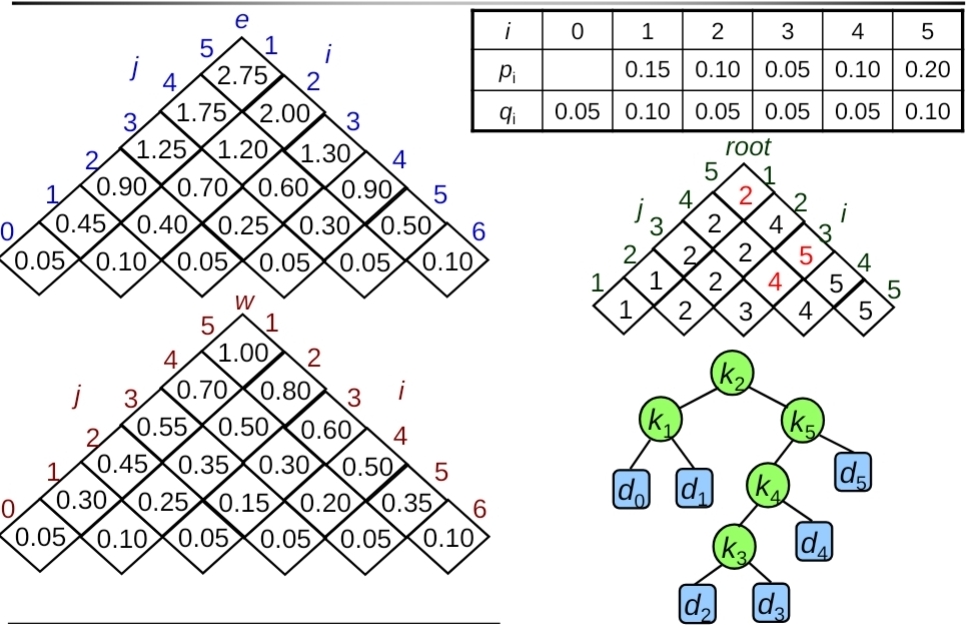
從root[1,5]開始看,是2代表$k_2$當作$[1,5]$的root,左半邊是$k_1$,右邊是$[3,5]$,那就繼續看,發現是5,代表$k_5$當root,依此類推,就可以得出所有root