Algorithm-Tree
這個章節主要在介紹binary-search-tree和紅黑樹的各種操作和演算法實作
| Operation | BST | RBT |
|---|---|---|
| Search Insert Delete Minimum Maximum Successor Predecessor |
$O(h)$ | $O(lgn)$ |
Binary Search Tree(BST)
和前面提到的heap結構不一樣
- BST主要為了「快速搜尋任意值」
- Heap:為了「快速拿到最大值或最小值」
規則:
- 左子樹所有值 < 根
- 右子樹所有值 > 根
- 中序走訪會得到排序結果
Operation
都可以在$O(h)$的複雜度做到,$h$代表tree的高度
- Search
1
2
3
4
5
6Iteratie-Tree-Search(x,k) // x代表目前的點,k代表想找的value while x≠NIL and k≠x.key if k<x.key x = x.left else x = x.right return x - Minimum
- Maximum
- Predecessor(前一個)
- Successor(後一個)
1
2
3
4
5
6
7
8
9
10
11
12Tree-Successor(x) // 只要考慮兩種情況 // 第一種是root本身往右邊找最小的就是successor if x.right ≠ NIL return Tree-Minimum(x.right) // 第二種是children要往上找才能找到successor y = x.p while y ≠ NIL and x == y.right x = y y = y.p return y - Insert
1
2
3
4
5
6
7
8
9
10
11
12
13
14
15
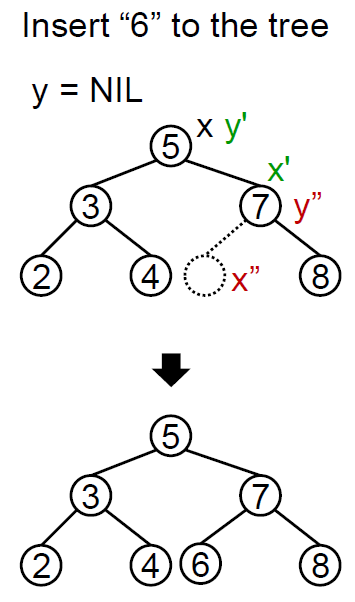
16Tree-Insert(T,z) // z代表要插入的node。分兩種情況,第一種是 插在某個parent底下當作children;第二種是要插入的z本身就是root y = NIL x = T.root while x ≠ NIL y = x if z.key < x.key x = x.left else x = x.right z.p = y if y == NIL T.root = z // 屬於要插入的z本身就是Tree的第一個node // 以下兩個都是第一種情況,z已經是y的children只是要區分比y大還是小 else if z.key < y.key y.left = z else y.right = z - Delete:分三種情況
- node z沒有任何children: 直接刪除
- node z有一個children: 把z的parent的children pointer改成z的children
- node z有兩個children: 把z.right中最小的node取代z
1
2
3
4
5
6
7
8Transplant(T,u,v) // 用v node取代u node if u.p == NIL // 代表u已經是root了 T.root = v else if u == u.p.left // u是child且比parent小 u.p.left = v else u.p.right = v // u是child且比parent大 if v ≠ NIL v.p = u.p1
2
3
4
5
6
7
8
9
10
11
12
13
14Tree-Delete(T,z) if z.left==NIL // Case A: 只有一個右邊的child Transplant(T,z,z.right) else if z.right == NIL // Case B: 只有一個左邊的child Transplant(T,z,z.left) else y = Tree-Minimum(z.right) if y.p ≠ z // Case D: 有兩個children且可以直接用successor取代z Transplant(T,y,y.right) y.right = z.right y.right.p = y Transplant(T,z,y) // Case C,D: 有兩個children且successor就是z.right y.left = z.left y.left.p = y
Red-Black Trees
- 可以保證tree的高度是$O(lgn)$
- 有五個屬性
- 每一個node不是紅就是黑
- root一定是黑
- NIL一定是黑
- 如果一個node是紅色,該node的children一定是黑色
- 每一個node往下看leaf任意路徑所碰到的黑色node數量會是一樣的
- 這些規則確保樹不會嚴重傾斜(balanced)
- 最多只需要3次rotation就可以保持平衡
Rotation
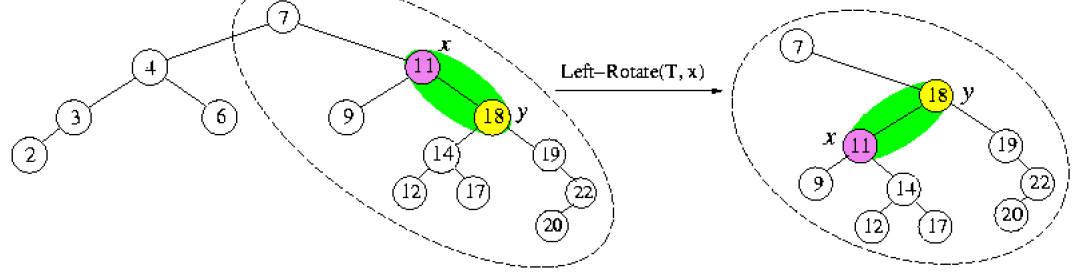
只有分右轉或左轉,都不影響BST的特性,只會改變structure
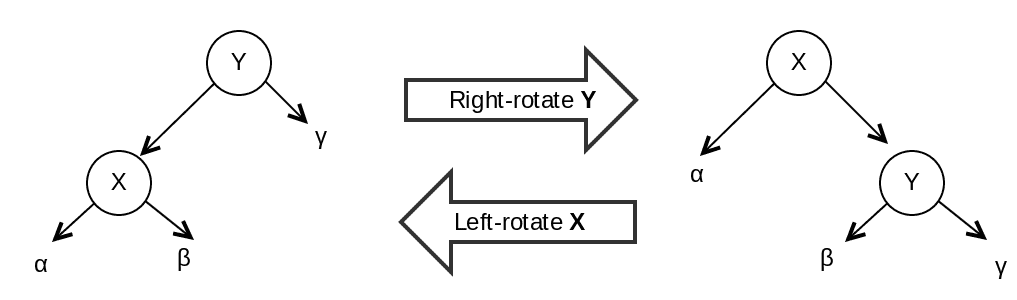
1 | |
Insertion
- RB-Insert
1
2
3
4
5
6
7
8
9
10
11
12
13
14
15
16
17
18
19
20
21RB-Insert(T,z) y = T.nil x = T.root while x ≠ T.nil y = x if z.key < x.key x = x.left else x = x.right z.p = y if y == T.nil T.root = z elseif z.key < y.key y.left = z else y.right = z /*---以上部分都和Tree-Insert一樣---*/ z.left = T.nil z.right = T.nil z.color = RED RB-Insert-Fixup(T.z) - RB-Insert-Fixup
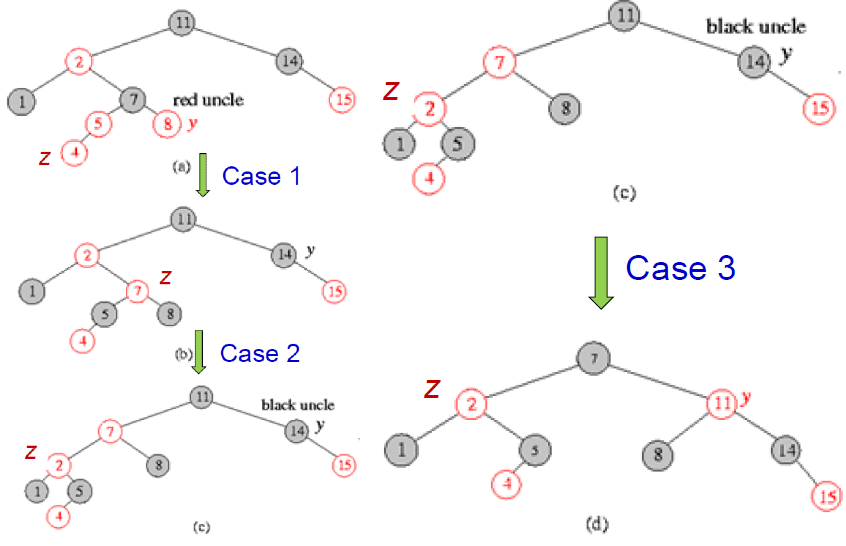
基本上就是一邊看課本範例一邊對照pseudo code的case,就大概知道邏輯怎麼跑,但要說他的case是基於什麼pattern,我沒有寫筆記,代表上課時也沒有特別講
1
2
3
4
5
6
7
8
9
10
11
12
13
14
15
16
17
18RB-Insert-Fixup(T, z) while z.p.color == RED if z.p == z.p.p.left y = z.p.p.right if y.color == RED z.p.color = BLACK // case 1 y.color = BLACK // case 1 z.p.p.color = RED // case 1 z = z.p.p // case 1 else if z == z.p.right z = z.p // case 2 Left-Rotate(T, z) // case 2 z.p.color = BLACK // case 3 z.p.p.color = RED // case 3 Right-Rotate(T, z.p.p) // case 3 else (same as then clause with "right" and "left" exchanged) T.root.color = BLACK
Delete
- z有一個chile
1
2
3
4
5
6
7
8/*---和Tree-Transplant幾乎一樣---*/ RB-Transplant(T , u, v) if u.p == T.nil T.root = v elseif u == u.p.left u.p.left = v else u.p.right = v v.p = u.p - z有兩個children
1
2
3
4
5
6
7
8
9
10
11
12
13
14
15
16
17
18
19
20
21
22
23RB-Delete(T ,z) y = z y-original-color = y.color if z.left == T.nil // case A x = z.right RB-Transplant(T, z, z.right) elseif z.right == T.nil // case B x = z.left RB-Transplant(T, z, z.left) else y = Tree-Minimum(z.right) y-original-color = y.color x = y.right if y.p == z // case C x.p = y else RB-Transplant(T, y, y.right) y.right = z.right // case D y.right.p = y Transplant(T, z, y) // cases C, D y.left = z.left y.left.p = y y.color = z.color if y original color == BLACK RB-Delete-Fixup(T, x)
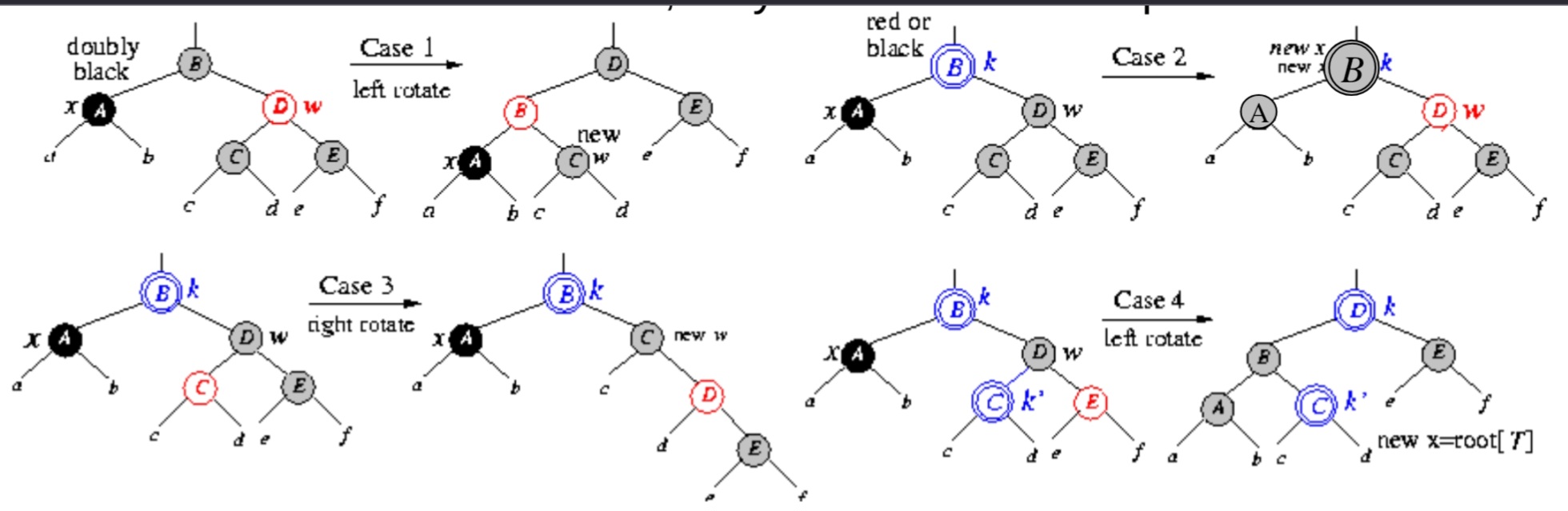
Deleteion-Color-Fixup
以下的case前提是x是x.p的left child
- Case 1: The doubly black node x has a red sibling w. 2.Case 2: x has a black sibling and two black nephews.
- Case 3: x has a black sibling, and its left nephew is red and its right nephew is black.
- Case 4: x has a black sibling, and its right nephew is red (left nephew can be any color).
1 | |